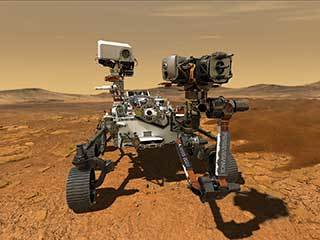
Livestream Commentary: Mars Perseverance Entry, Descent, and Landing

I will be hosting live commentary over Zoom during the Entry, Descent, and Landing of Mars Perseverance.

When: Thursday, February 18, 2021 12:20pm-1:15pm

Where: Register in advance for this meeting (because it is public)

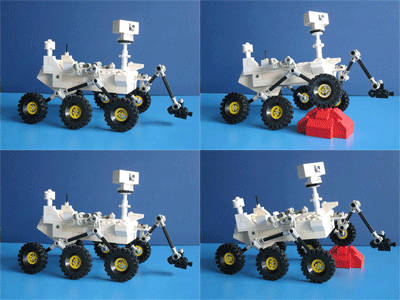
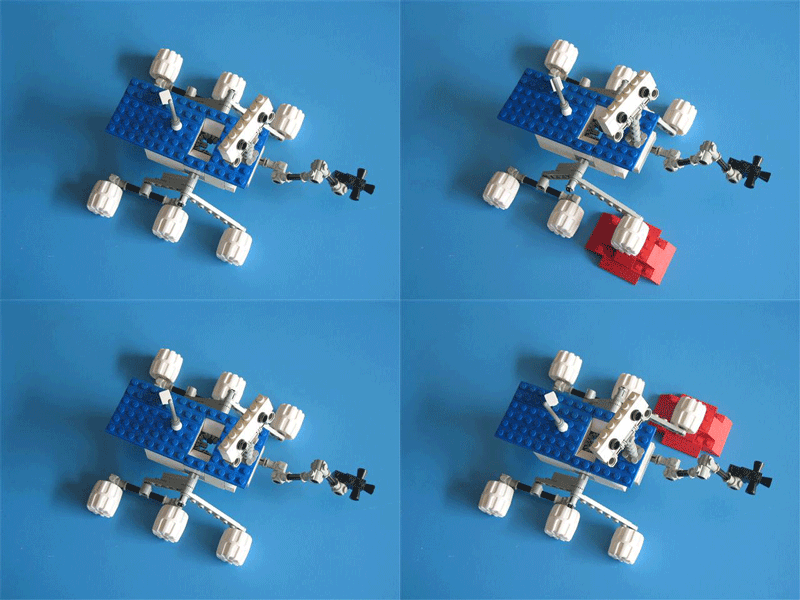
A rover on Mars with six wheels, a camera on a mast, and an arm with equipment on it.

I will be livestreaming the splashdown via https://mars.nasa.gov/mars2020/timeline/landing/watch-online/ within the commentary. I will be chatting directly with you, and will attempt not to be talking over the NASA official commentators, but explaining some terms they use and answering your direct questions.

To watch the livestream of the launch on your own go to NASA’s Mars Landing site to get the best links from NASA.

Also, here are some great activities and information to get you started.

<iframe src="https://mars.nasa.gov/gltf_embed/25042" width="100%" height="450px" frameborder="0"></iframe> <iframe src="https://mars.nasa.gov/gltf_embed/25043" width="100%" height="450px" frameborder="0"></iframe>

See you later this month!

-Alice

Watch the MAVEN Launch With Me: Monday at 10am Pacific

Hey everyone, I’ll be live-Google-Hangouting from the MAVEN launch (next mission to Mars) in Florida on Monday morning (November 18th. The launch is at about 10:20 Pacific Time, so tune in around 10am.). That’s right, you get me as an on-location reporter for this launch for the first time ever … I’ve never been to a real in-person launch before. I’ll be watching from the Causeway.

I’ll be co-hosting with Shannon Hall and Sarah Culp, who will be Hangouting from Pacific Science Center. Turn on NASA TV in one browser, and join our Hangout in another. Can’t wait to see you! I’ll be posting links here as I get them, and if all else fails check in on my Twitter and Pacific Science Center’s Twitter to get the full scoop that morning!

You can also join Shannon and Sarah in person at Pacific Science Center, details to follow later this afternoon.


Edit to add: You can listen to my interview on KOMO about the MAVEN launch if you missed this hangout or the interview on the actual day of launch.

~ A l i c e !

Mars Rover Rocker-Bogie Differential

Today’s is a guest post, brought to you by my father, engineer, physicist, computer programmer, and Lego, Mars, and animation enthusiast: Keith Enevoldsen. If you’re not caught by the title of the post, scroll down and look at the pictures… then scroll back up and read the rest of the article because it is fascinating stuff! (P.S. He has a website full of awesome science stuff too!)

A teaser for what you have to look forward to…

~ A l i c e !

The Rocker-Bogie

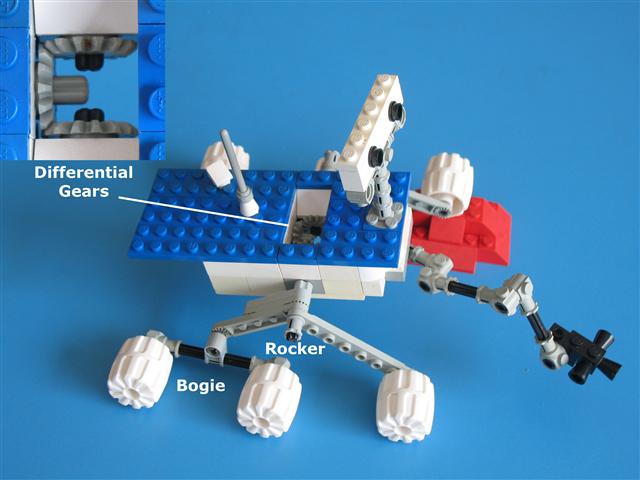
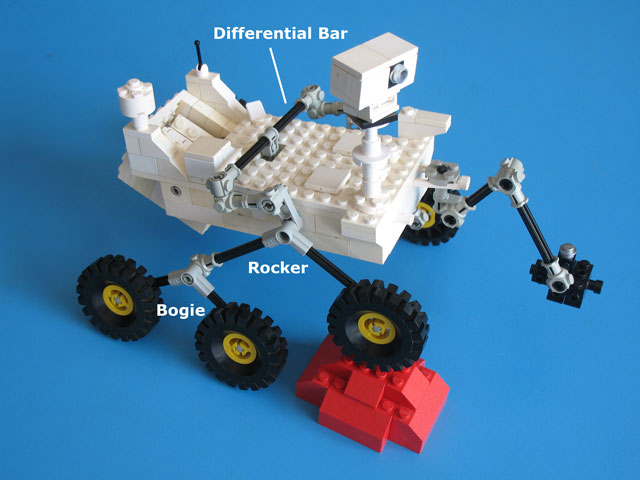
All the Mars rovers have six wheels and use a rocker-bogie suspension system to drive smoothly over bumpy ground. The rocker-bogies are easy to see in pictures of the rovers (see pictures below). There is one rocker-bogie assembly on each side of the rover. The rocker is the larger link that connects to the rover body (the chassis) in the middle (at the rocker pivot), has a wheel on the front, and connects to the bogie in the back. The bogie is the smaller link that connects to the rocker in the middle (at the bogie pivot), and has wheels at both ends. Each of the six wheels has its own motor.

The Differential

It is not so easy to see and understand how the rocker-bogie mechanism keeps the body level. What prevents the rover body from tipping all the way forward or backward around the rocker pivots? If you build a model rover and you attach the rockers to the body with an axle or two pivot pins, the body will tip forward or backward until it hits the ground! In the real rovers the two rockers connect to each other and to the body through a mechanism called a differential. The differential is what keeps the body level. Relative to the body, when one rocker goes up, the other rocker goes down. Relative to the ground, the body angle is halfway between the angles of the two rockers. That’s cool, but how does it work? The different rovers use different mechanisms: a differential gearbox or a differential bar.

Differential Gearbox

The Mars Pathfinder (Sojourner) and Mars Exploration Rovers (Spirit and Opportunity) use differential gearboxes.

MER’s Differential
Image and Model © 2012 Keith Enevoldsen

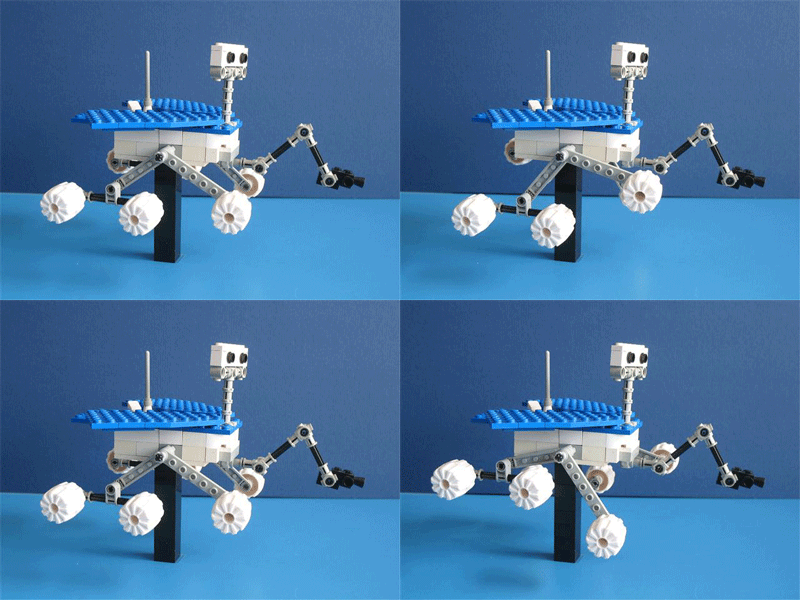
The gearbox is inside the rover body, so you never see it. No wonder it is hard to figure out how it works! In my Lego model rover shown here, I use a simple three-gear differential. Two gears connect to the two rockers and the third (middle) gear connects to the body. If you hold the model rover body steady in midair and tilt one rocker up, the gears will turn and the other rocker will tilt down (see the animations below).

The real Mars Exploration Rovers use more complicated gearboxes with more gears but they are functionally equivalent to this simple three-gear differential.

Differential Bar

The Mars Science Laboratory (Curiosity) uses a differential bar. This is the big black bar that you see across the deck of the rover.

Curiosity’s Differential
Image and Model © 2012 Keith Enevoldsen

The middle of the bar is connected to the body with a pivot and the two ends are connected to the two rockers through some short links. If you hold the model rover body steady in midair and tilt one rocker up, one end of the bar will go back, the other end will go forward, and the other rocker will tilt down (see the animations below).

The Mars Exploration Rovers did not use a differential bar because it would interfere with the solar panels. But the Mars Science Laboratory does not have that problem because it is nuclear powered and has no solar panels.

Animations

Animations of a Rocker-Bogie with a Differential Gearbox

Mars Exploration Rover (Spirit and Opportunity)

Body held steady in midair:


Wheels on the ground:


Animations of a Rocker-Bogie with a Differential Bar

Mars Science Laboratory (Curiosity)
Body held steady in midair:

Wheels on the ground:


No Springs

The rocker-bogie mechanism has no springs. The absence of springs helps it keep all six wheels on the ground with approximately equal pressure on each wheel. This is a good thing when you are driving on sand!

Want More? (and References)

“Mars Exploration Rover Mobility Assembly Design, Test and Performance”, JPL

“A Capable and Temporary Test Facility on a Shoestring Budget: The MSL Touchdown Test Facility”, JPL


I hope you enjoyed my dad’s post. He sure had fun figuring out those mechanisms and creating them out of Lego!

I’ll be posting a Curiosity-landing-“watching” event here very soon.

~ A l i c e !

Summer Solstice Sunset – 2010

  • When: Monday, June 21, 2010 at 9:11pm (so come at 8:30pm)
  • Where: Solstice Park (or, if you’re not in Seattle, wherever you have a view of the western horizon!)
  • Who: Everyone welcome, as usual.

Sunset on June 11, 2009 Credit: Jason Gift Enevoldsen

Come watch the summer solstice sunset at Solstice Park in West Seattle on Monday. We’ll see if the sunset lines up with the placed marker. I’ll be there even if it is cloudy because sometimes the Sun peeks through just as it begins to set, but if it is driving rain I’m staying home with a cup of tea.

If it is clear we’ll bring a telescope or two to take a look at the Moon after the Sun goes down – and Mars and Saturn if we stay until it is dark enough. We will not be able to see the comet – that rises a little before 3am, and I plan to get some sleep before Tuesday. You’re welcome to look for the comet on your own though!

If you’re interested – here’s the timing of various celestial events on Saturday from Seattle, courtesy of the U.S. Naval Observatory Astronomical Applications Department:

Sun and Moon Data for One Day

The following information is provided for Seattle, King County, Washington (longitude W122.3, latitude N47.6):

Monday   21 June 2010          Pacific Daylight Time

SUN
Begin civil twilight       4:31 a.m.
Sunrise                    5:11 a.m.
Sun transit                1:11 p.m.
Sunset                     9:11 p.m.
End civil twilight         9:52 p.m.

MOON
Moonrise                   3:29 p.m. on preceding day
Moonset                    1:36 a.m.
Moonrise                   4:45 p.m.
Moon transit               9:29 p.m.
Moonset                    2:05 a.m. on following day

This event is my part of the NASA’s Solar System Ambassadors program, and thanks to West Seattle Blog for publicizing the last few!

Everyone is welcome, see you there!

~ A l i c e !

Mineral Indications of Water

What you need to know:

Carbonates (like antacids that you dissolve in water) dissolve easily in water, and are deposited easily out of water. Sulfates (which are why Yellowstone’s fantastic mud-pots smell awful) are similar. Silica-rich deposits are more commonplace – so you need more detail to tell if they’re from water or not.

Up until now you’ve taken it for granted when you read in an article that a mineral discovered on Mars indicates the prehistoric existence of water. But how can a certain mineral in a rock tell you that there was once water? How can it tell you if that water was more recent or more ancient?

Carbonates

There are many carbonates, but calcium carbonate is probably the most familiar to you – and one of the most common carbonates. As you know from taking Tums or Alka-Seltzer – these dissolve easily in water. Many seashells are made of carbonates as well, and when those animals die, the shells are dissolved into the ocean and eventually that calcium carbonate is redeposited as limestone. Like that, all carbonates are usually formed in “hydro” and hydrothermal situations, and are also later dissolved by even a slightly acidic situation. Although this example only represents redeposition of carbonates – they are also deposited primarily (in the first place) by water as well. Finally, in order for carbonates to last a geologically long time they must be protected from water and other acids. Carbonates are either a good indication of water activity in the geologically recent past, or there hasn’t been any water near them in a long, long time.

Carbonates in ALH84001 (one of the meteorites from Mars)

Sulfates

Sulfate minerals are similar to carbonates in terms of their indication of water – they are also water-soluble, and occur in similar places to carbonates: embedded with limestones, etc. Sulfates tend to need more “thermal” in the term “hydrothermal” than carbonates – which is why you find a lot in volcanic regions like Yellowstone. That rotten-egg smell associated with hydrothermal areas on earth is due to the sulfur in sulfates. Sulfates are a great indicator for water activity paired with heat.

Spirit Unearths Sulfates on Mars

Silica

Almost every rock on Earth is silica-based. The presence of silicates in and of themselves is not an indication of water, current or prehistoric. More analysis or specificity is needed. After oxygen (yes, oxygen!) silica is the most common element in the Earth’s crust, as well as the crust of the Moon, and what we know of the surface of every other terrestrial planet.

Where’d I Get My Info?

Klein, Cornelius. The 22nd Edition of the Manual of Mineral Science.

~ A l i c e !

Magnetotactic Bacteria

Magnetotaxis is movement along magnetic field lines, from Latin magnes (magnet) and Greek taxis (arrangement). The Latin magnes is itself from Greek ho Magnes lithos “the Magnesian stone,”(This is what my etymology research turns up, if you know more, let me know so I can pass it on!)

Where Do They Live?

Magnetotactic bacteria on Earth are found in a layer of water called the oxic-anoxic transition zone: where the water goes from having oxygen to not having oxygen. The bacteria often occur within sediments (like the muck at the bottom of a pond – but that’s a simplified example). They don’t occur in all water at this transition zone, the water must be exactly the right composition.

There are many types of magnetotactic bacteria on Earth. The shapes include: coccoid (connected bubbles), ovoid, rods, vibrios (curved rods), & spirilla (spirals).

Movement

All know magnetotactic bacteria on Earth have flagella (tails) for movement. They orient along magnetic field lines and actively swim along those lines. Dead magnetotactic bacteria do not move along magnetic field lines.

Some northern hemisphere magnetotactic bacteria swim along the geomagnetic field towards our North Pole. Some southern hemisphere magnetotactic bacteria swim along the geomagnetic field towards our South Pole. Since our magnetic field is centered on the center of the earth, these magnetotactic bacteria are swimming along the field line in the direction of “down.” It was originally thought that this was to allow the bacteria to burrow down deeper into the sediment. It has since been discovered that magnetotactic bacteria also use aerotaxis. Wahhh! Too many big words! Aerotaxis: move to or away from oxygen. So really, the bacteria not preferentially going “down” the magnetic field line, they’re preferentially going away from the oxygen and also happen to be moving along the magnetic field line.

How Do They Work?

Magnetotactic bacteria have structures inside them, magnetosomes, which contain crystals of iron. Those crystals are magnetic: magnetite. There’s a “skin” (membrane) around the magnetosomes – it probably helps the bacterium control the growth of the magnetite crystals. Most freshwater magnetotactic bacteria create magnetite (iron & oxygen), but many marine and salt-water species create greigite (iron & sulfur) instead.

Here’s what matters in terms of finding magnetite in that Martian meteorite: “The narrow size range and consistent morphologies of the magnetosome crystals in each species or strain are clear indications that the magnetotactic bacteria exert a high degree of control over the processes of magnetosome formation.” (Frankel) In other words, the magnetite crystals are very, very similar between bacteria, and that’s the type of magnetite crystal found in the Martian meteorite ALH84001.

Want More?

Check out CalPoly’s page.

~ A l i c e !

Answering Questions: Life on Other Planets?

Here are my questions:

  1. What is the possibility that intelligent life on other planets exists?

  2. Have we found any signs of life on other planets?

  3. What is the possibility that any life will be found on a moon such as Europa or Titan?

Again, I greatly appreciate your time, and thank you in advance for your response.

Many Thanks,

-Jacob

Jacob, ahh, these are the questions driving our exploration of the solar system.

1. What is the possibility that intelligent life on other planets exists?

This question is more of an opinion question at this point than a science question. There are just beginning to be scientists attempting to put a number to the possibility that there is life on other planets. I’d like to break this question down.

Life within our solar system (other than on Earth)

There is no evidence of intelligent life within our solar system. This does depend on your definition of intelligent, but one definition sometimes used by astronomers is that intelligent aliens would be able to form civilizations and use radio communication. We would have picked up those radio signals long ago had they been created within our solar system. It is entirely possible that there is life that is not creating radio signals – but we might have detected that life in other ways too:  noticing extra heat, carbon dioxide, oxygen, or methane in the atmospheres of other planets and moons within our solar system.

There is a scientist – Dr. Abel Méndez from Puerto Rico who is studying how likely it is that life could survive (the habitability of) on various planets and moons. He has actually ranked Enceladus, Saturn’s moon, as having more habitable area than Earth!!

Life outside our solar system

Since we have not yet found evidence of life outside our solar system, we have no way of knowing if it is there or not. If you like, you can use the Drake Equation to make your own guess, based on your own choices for the percentage of stars that you think might have planets, and the percentage of those that might be habitable.  If you talk to your math teacher about how to use this formula you can get your own best guess. If you’d rather though, scroll to the bottom of this page and choose the numbers you like best, and the webpage will calculate it for you.

2. Have we found any signs of life on other planets?

Hmm. Not really. Scientists are looking for what they call “markers” of life or “markers of biogenic activity” (both phrases mean the same thing). For instance – if you see dog poop in the park, although the poop isn’t alive you can be pretty certain that there was a dog at that exact location not too long ago. Most of the markers scientists are looking for aren’t nearly as certain as that.

Methane

A while ago scientists studying Mars found new methane in the atmosphere. Methane is often produced when life forms digest food – it comes out of your body when you burp or fart. Bacteria make methane too, as do dogs, cows, and other animals. Unfortunately, the rock cycle can also make methane – especially when iron rusts. Mars is covered in rust – that’s why it is red. This discovery of methane could be either from geology or from biology, it is not necessarily a “marker of life.”

Magnetotactic Bacteria

Last week I wouldn’t have mentioned this, but there is a new scientific paper out this week. In 1996 scientists found what they thought were markers of life in a meteorite from Mars. This meteorite (ALH 84001) was discovered in Antarctica in the early 80s. There were two interesting things inside this meteorite: forms that might be fossilized bacteria, and strings of magnetite (a magnetic mineral). We can’t really tell about the shapes that might be fossilized bacteria, but the strings of magnetite are identical to magnetite strings created by certain bacteria (magnetotactic bacteria) here on Earth. This is a very new paper, so other scientists might have other ways to interpret the same information.

3. What is the possiblity that any life will be found on a moon such as Europa or Titan?

If you look at the work done by Dr. Abel Méndez it looks fairly likely that life might have begun on Europa or Enceladus. Titan is less likely, as is Mars. How likely is it that the life is still there or that we’ll find it? I don’t know. Scientists are constantly debating this one.

Useful Links

Dr. Abel Méndez on Planet Habitability

Methane on Mars

Magnetotactic Bacteria

Magnetotactic Bacteria from NASA

Advanced Links (My source material)

(These are source material, but I do not recommend them unless you want to spend hours piecing through the jargon)

Press release about Méndez’s work, with diagram

Méndez’s current abstract

Méndez’s previous article

~ A l i c e !

Magnetotactic Bacteria from Mars?

I read the papers. No, I mean the peer-reviewed scientific papers. The upshot is this. In 1984 we discovered a meteorite in Antarctica and proved it was from Mars. In 1996 a group of scientists released a paper claiming that there might be evidence for life in that meteorite, most famously in the form of  “fossils of bacteria” (I’ll get more technical on that later). It didn’t take long for other scientists to come up with a series of other possible sources for the markers that the first group were claiming as markers of life. Although the work continues, for the last 13 years it has been widely accepted by the public and by many scientists that the markers in the meteorite (ALH 84001) were not formed by bacteria, they were formed by “plain old  geology”. No life.

Well, last week that changed (as new science is wont to do). A group of scientists has been looking closer (literally, they’re using better electron microscopes than we had in 1996) at ALH 84001 for the last 13 years, and last month they published a paper claiming that the suggested geologic processes could not have made the formations found in the meteorite. In other words they disproved the disproof of their original hypothesis, which was that there was once life in this rock. Now, and this is very important to note, they do not claim to have found proof of life, or to have found indications of life. They simply claim that the possibility of a “biogenic origin” is once more back on the table. (Last update: 12/1/2009)

Magnetotactic Bacteria from NASA Johnson Space Center

Magnetotactic Bacteria from NASA Johnson Space Center

Carbonates and Magnetotactic Bacteria

Explaining magnetotactic bacteria would overwhelm this AstroInfo, so I’ll save that for next time. Suffice it to say, there are bacteria that create very pure nano-scale (really-über-tiny) magnetite. When Kathie (K.L. Thomas-Keprta, primary author) and her team examined the magnetite in ALH84001 they found it identical to the magnetites created on Earth by magnetotactic bacteria. Most importantly – it was extremely pure. This magnetite was associate with carbonate grains in the meteorite, and carbonate is an indication of water. If the magnetite had formed from or with the carbonate it wouldn’t have been as pure as it is.

I look forward to reading any rebuttals put forward by scientists who do not see this as evidence of possible ancient bacteria on Mars.

Where’d I Get My Info?

Press Release
Paper 1: Origins of magnetite nanocrystals in Martian meteorite ALH84001 (Peer-Reviewed)
Paper 2: Life on Mars: New Evidence from Martian Meteorites (Invited Paper)
Magnetotactic Bacteria

~ A l i c e !

Answering Questions: Life on Mars?

Kiri writes –
Ok, then–thanks very much! Now… *clears throat*

  1. Do you know of any unfrozen water on Mars?
  2. Is there any evidence of life on Mars’s moons?
  3. What is/are Phobos and Deimos’s general profiles? (i.e.
    Atmosphere, temperature, ect.)
  4. What might Martians be like?
  5. What are some famous theories on Martian life?

Thank you very much for your time!

Kiri, good questions. I will take them in order.

Unfrozen Water on Mars

First I will refer you to a blog post I try to update every time there is a discovery of water on Mars.  Pretty much all of these discoveries are of ice – though some are of ice that sublimes (evaporates) into a gas.

You know how when you have an ice cube, if you let it sit out it melts into a puddle of water, and if you let that puddle of water sit out eventually it evaporates and you’re left with nothing? Well, on Mars you get to skip the “puddle of water” part, and ice evaporates directly, without melting first. This is called subliming. Intriguingly this happens in Seattle fairly often too: when we get enough snow to cover the ground the air is usually also pretty dry. We usually do not have rain for a few days. You can watch how the snow disappears, but the ground around the snow stays dry.

Here is a picture of what it looks like:

Subliming snow

(thanks to “milesfromnowhere”)

Notice how the ground around the snow is not wet, but you can tell that there is now less snow than there was when the snow must have fallen? On Mars this is what almost always happens, because it is so cold on Mars.

Now, here’s the other piece.
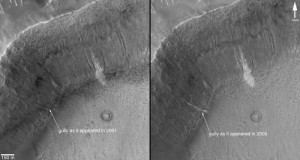
This is evidence of liquid water. As you know from seeing rivers, streams, and from looking at the Grand Canyon, water can shape the land. It can cut valleys, pick up loose dirt, and even reshape rocks. In the pictures linked to in this press release you can see a new gully.
From NASA: Gullies on Mars

From NASA: Gullies on Mars

There are other ways this gully could have formed, but it does look quite a lot like a gully formed by flowing water. Although NASA didn’t catch a picture of the water itself, this suggests that there was liquid water flowing on Mars between 1999 and 2005.

Life on Mars’s Moons

Nope. Mars’s moons are tiny rocks in space, there is no indication that they have the things we think are necessary to support life: liquid water, a temperature at which water can be liquid, and preferably an atmosphere of some type.

Phobos and Deimos’s General Profiles

I love picking up information like this from Bill Arnett’s Nine Planets and the NASA site also has some good information.

Phobos has an average diameter of 22.2 km – that’s like the distance from the Pacific Science Center to SeaTac Airport. For comparison, our Moon has a diameter of 3476 km or the distance from Pacific Science Center to Chicago. Deimos is a little more than half the size of Phobos: 12.6 km or a little less than the distance from Pacific Science Center to the Museum of Flight.

It is probably useful to think of Phobos and Deimos as small asteroids rather than as moons – they do in fact orbit Mars, but they’re just tiny rocks. They are thought to be partially ice inside, and Phobos has a thin layer of dust like our Moon. Surface dust on other bodies besides the Earth is called “regolith,” the word “dirt” is reserved for our planet, and for surface material that has some organic material. The dirt we’ve got here is partially ground up rock, but also partially decomposed plant and animal matter: organic material.

Both Phobos and Deimos are too small to have atmospheres. In order to have an atmosphere you have to be able to “hold on” to that atmosphere – you have to have enough gravity to keep the atmospheric gasses from drifting off into space. Phobos and Deimos do not have enough gravity to do that. Even Mars loses a lot of its atmosphere to space because it is so small, and it is a lot bigger than its moons.

The temperature on both moons varies a lot. With no atmosphere to mellow out the temperature the daytime side is cold (Phobos was measured at 25F) and the night side is really freezingly cold (-170F on Phobos). I do not plan to visit anytime soon.

Martians

Seeing as how we haven’t found any yet, if we do find Martians I’d expect them to be microscopic life forms – bacteria, algaes, or maybe lichens. Anything would have to adapt to using ice instead of liquid water, and be able to be frozen for months at a time.

But, if we toss aside the fact that we haven’t found anything yet and start to think of larger lifeforms we can combine what we know scientifically with our imaginations to come up with what we might have found. Consider:

  • Mars has lower gravity than Earth
  • Mars has a thinner atmosphere than Earth
  • Mars’s atmosphere has more carbon dioxide and less oxygen
  • Mars is much colder
  • Mars has very little liquid water, so life would have to use ice instead

My dreamed-up Martian would be very tall (because of the lower gravity), have huge lungs (to get enough oxygen), be covered in a thick layer of fat and fur like a polar bear (because of the cold), and would have very warm stomach, so that as it ate ice the ice would melt and turn into liquid water inside.

How would your dreamed-up Martian adapt to these conditions?

Famous Theories on Martian Life

The most famous are all in science fiction – but there was one scientific discovery that caught the limelight for while. It was later determined to be incorrect, but it was exciting anyway.

The meteorite that started it all was called ALH84001 – and a team of scientists announced that they had found evidence suggesting fossilized microscopic organisms inside this meteorite from Mars.

Here is a recent article about Life on Mars, and here is one of the original websites about this meteorite. Bear in mind as you read this one that it is completely out of date, and the shapes that were thought to be fossilized microscopic organisms were determined not to be.

I hope that is helpful!

~ A l i c e !
Vacations to Mars and Pacific Science Center

I’ll bet most of you reading this post are dropping by because you want to visit Mars. (What? You don’t know that Expedia is selling vacation packages to Mars? Well, you really should go book your seat RIGHT NOW before they sell out.)

The funniest thing happened to me earlier this month, I got an e-mail from my friend Corinne Cooley with five extremely detailed questions about Mars. I did my best to help her out, and it turns out she was one of the masterminds behind arranging those vacation packages, and got me that nice link at the bottom of Expedia’s Flights to Mars page.

I’ve had to keep my answers under wraps until today (you wouldn’t want all the seats to be sold before they’ve even announced they’re selling them, would you?) but finally, here they are.

Question(s) One: Would star-gazing on Mars be as good as I think it would? The atmosphere is a lot thinner. On the other hand I know it can be very dusty. What are your thoughts for on average, and in best conditions? If dust can’t be up to have good gazing, are there any regions on Mars that are significantly less prone to dust storms, or significantly less impacted in a ‘visibility through atmosphere’ sense?

Impacts on Stargazing:

  • Light Pollution – you’ll have none of this, and this takes our viewing from the ability to see ~4000 stars on Earth to seeing ~100 in a city.
  • Moon Glow – another form of light pollution, but with tiny moons, you’re not going to have a problem here at all. You also will never see a beautiful crescent moon set just after the Sun, or a solar eclipse.
  • Atmosphere – This affects seeing more than it affects ability to see. Whoa – confusing? Atmosphere will make things wobbly, and more atmosphere will blot out some dim stuff you can see. Although the astronauts have the best view ever, they could also only probably see about ~4000 – ~6000 stars if they were looking away from the Sun and their eyes adjusted. We can see that lower number from a great location on Earth.
  • Water Vapor (clouds etc) – We have a lot of this on Earth. There is some on Mars too – we saw snow falling from clouds towards the Phoenix Lander, and we have time and again seen clouds on Mars. You’ll have SIGNIFICANTLY less, so I would not expect your stars to twinkle nearly as much as they do here.
  • Particulate Matter (dust storms) – So, Mars has periodic global dust storms. Looks like ten in the 30+ years that we’ve been watching. At this time you’ll see nothing, and you’ll hunker down under a rock and wait for it to pass.

Quote from Dr. Tony Phillips: “Because the martian atmosphere is thin–about 1% as dense as Earth’s at sea level–only the smallest dust grains hang in the air. “Airborne dust on Mars is about as fine as cigarette smoke,” says Bell. These fine grains reflect 20% to 25% of the sunlight that hits them; that’s why the clouds look bright. (For comparison, the reflectivity of typical martian terrain is 10% to 15%.)”

  • Even looking through smoke is no good for stargazing, so I’d avoid the dust storms altogether. I’ve heard of two big dust storms coming out of Hellas Basin – and I’d avoid all the plains. More research is necessary, but that’s my first shot.

P.S. You’ll have a different North Star, but all the constellations will be the same

See the Moons of Mars for yourself! (from NASA)

Stargazing from Mars - those are the two moons going by. (from NASA)

Question(s) Two: I’m interested in the concept of Martian tourism. Imagine a lightly developed Mars – you can get up there, there are multiple places you can go to and there’s support for people to stay there, but it’s not all the way ‘tamed’ by any means. What would be the coolest things to do? Of course you have less gravity, extra minutes in the day, and the biggest mountain and canyon in the solar system. Anything jump to mind beyond the obvious?

  • Walking up the smooth side of Olympus Mons would be like a stroll in the park – as long as you can keep up the stroll for 375 miles. The grade isn’t even a hike – it’s ADA compliant (you could go up it, easily, in a wheelchair). Now the other side – the scarp – is an ~11km tall vertical cliff. Different story.
  • I’d check out the landing sites for the Vikings, Pathfinder, Rovers, and Phoenix. I’d also go on an expedition to see the Beagle crash site.
  • Watch out when you’re at the side of Valles Marineris – I’ve heard the winds sweeping over the sides and into the trench could knock you over. I tried to double check that, and came up with nothing though…
  • I’d be interested in exploring those fjord/trenches up by the North Pole – they look … interesting.
  • Credit: “Fjords” at the North Pole http://www.windows.ucar.edu/tour/link=/mars/places/mars_poles_image_gallery.html
  • “Search for Water” – if we had people there, they could go to those crater walls where we’ve been seeing seepage and figure out for sure what it is. I’ll bet this would be as attractive as dowsing.
  • “Chase the Dust Devils” – we don’t understand these even on Earth, and there are tons on Mars.
  • The Face on Mars – it’s just a field of rubble, you won’t see anything there, but you could go anyway. (Expedia included this, it’s Activity #6 – Pareidolia Tour!)
  • No matter what you’re going to need a warm polar jacket. Like the ones they take to Antarctica.

Question(s) Three: Mars humor. Are there any really great/terrible Mars specific jokes that you are aware of? Or even farther out, general astronomy humor? I’m looking for humor that would be mildly accessible to a layperson but thrilling to a geek.

I don’t have ANYTHING really. My favorite is that HP ad that was on TV where the Martians are printing out the Panorama just as fast as Pathfinder can take the pictures.

  • How can you tell Mars isn’t married?
  • It doesn’t have a ring.

Classic, can be used for the Moon too:

Person1: Hey, I went to Mars the other day

Person2: Wow! Cool! How was it?

Person1: Meh, there wasn’t much atmosphere ….

A “bad” collection.

Question(s) Four: Any super super cool recent Mars happenings? Any really interesting current mysteries that would be fun to speculate on? (I heard there’s methane emissions going on up there, indicating either geologic or biologic activity…)

  • Yeah, that methane is almost certainly geologic. The cool part about it is that it is renewing itself. That means there is a source where something is happening.
  • Mars Odyssey successfully rebooted!
  • Spirit and Opportunity both had errors recently – but they’re back up and running. This is not unexpected, they’ve lasted 5 years when they were supposed to last 90 days! (I love it when the rover’s solar panels are cleaned by wind)
  • We got a beautiful picture of Deimos.
  • Lobate flows can be kinda a big deal.
  • We found water on Mars!!! (Over and over and over and over again)

Question(s) Five: I’ve seen Yahoo is doing a Mars weather forecast. I need to do more digging myself but do you know anything about where this kind of data might be publicly accessible? (RSS feed would be the BEST.)

Alice Enevoldsen

~ A l i c e !

Where’d I Get My Info?

Stargazing and Dust on Mars

This was the original intro to this post. It doesn’t make sense now that Expedia’s not pushing their April Fools site as heavily. (Changed 4/2/2009)

Hello! Welcome newcomers, to Alice’s AstroInfo!

If you’ve gotten this far you probably want to know more about me. The best way would be to click over and visit my place of employment:

Pacific Science Center

It’s an awesome interactive science museum in Seattle, Washington (USA) and if you visit their website, you could help show them that my little blog and I are a force to be reckoned with!